Pipe Dream Plumbing
Call (858) 330-2881

Professional Plumbing Service

Water Softeners in San Diego County and the Temecula Valley

A water softener removes the calcium and magnesium that make water hard. Pipe Dream Plumbing Co. installs salt-based softeners across San Diego County and the Temecula Valley, sized to a hardness test at your tap, and tells you where a salt softener is not allowed.

Thomas, lead tech at Pipe Dream Plumbing, standing next to the company van

By Thomas, Lead Tech, over 20 years of plumbing experience. Last updated:

A water softener is a tank of resin beads at your main line that pulls calcium and magnesium out of the water, so it stops leaving scale in your water heater, on your fixtures and on glass. You need one when hard water is wearing out appliances early, spotting everything and crusting your faucets. We install them across San Diego County, the Temecula Valley and the Inland Empire, anywhere a salt softener is allowed. Our whole-home water softener plus filtration is $2,495 installed, equipment included.

Most of the water we work with is hard to very hard. Helix Water District's 2025 report puts its treated water at 12.0 grains per gallon, and Rancho California Water District's imported water at 230 mg/L. The U.S. Geological Survey calls anything above 180 mg/L very hard. Hardness is about scale and wear, not safety: the water meets drinking water standards either way.

This page is about the softener itself. For filtration, reverse osmosis and the combo that pairs a softener with whole-house filtration, see water filtration and softening.

Prices are estimates and may vary based on job complexity. Call for a free, no-obligation quote.
How do you know your home needs a water softener?

White crust on faucets and shower heads: That chalky buildup is calcium and magnesium left behind as water dries.
Spots on glass and shower doors: Spots that come back right after cleaning are hardness minerals.
Water heater rumbling or failing early: Scale settles in the bottom of the tank and the burner heats through it. A softener stops new scale from forming.
Soap that will not lather: Hard water fights soap and shampoo, so you use more and rinse longer.
Your home has a softener loop: Many newer homes have one roughed in at the garage. It makes the install simpler.
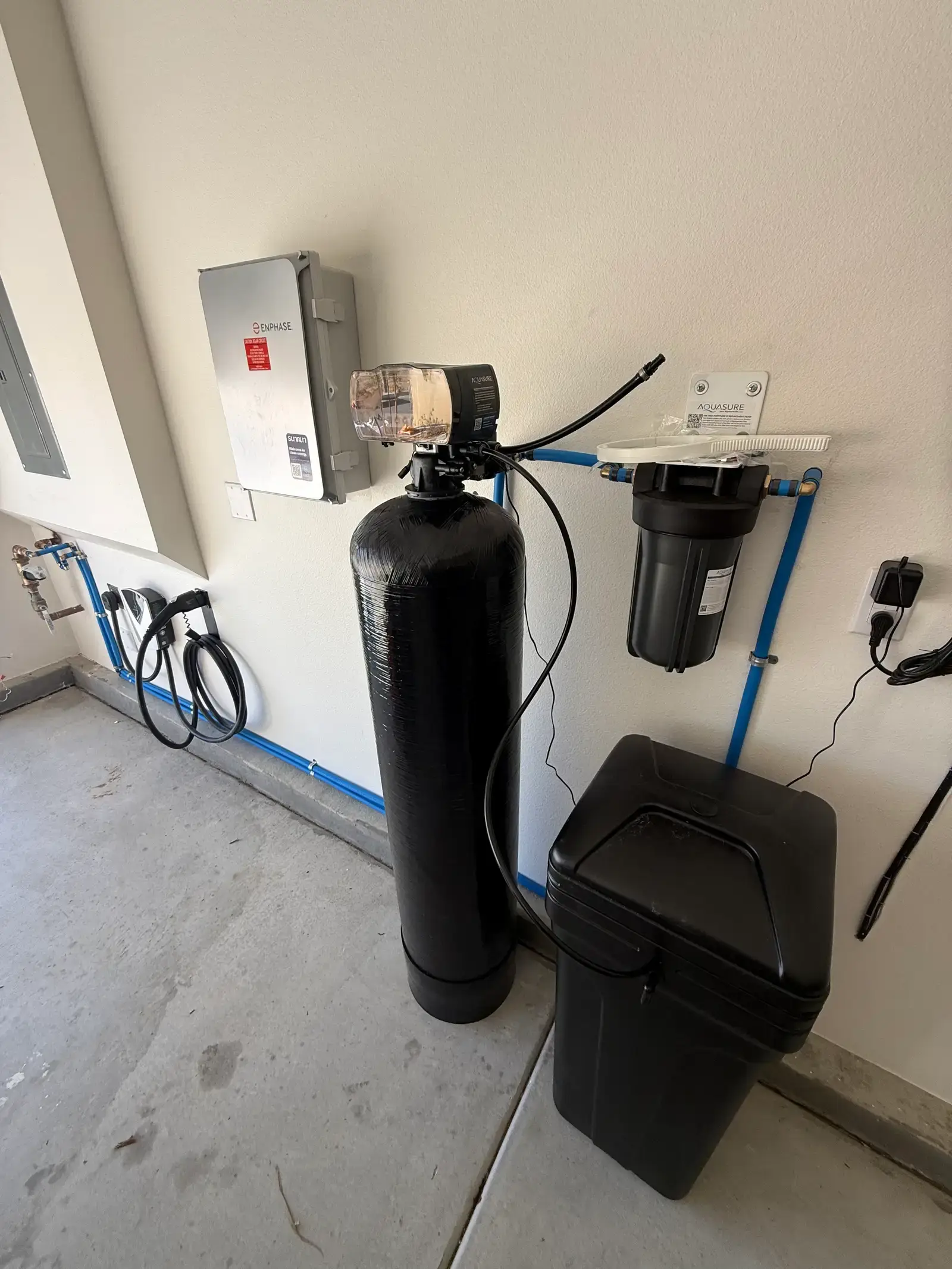
Water softener tank and brine tank installed in a garage, with a prefilter mounted on the wall
A recent water softener installation by Pipe Dream Plumbing

How does a water softener installation work, step by step?

1

Test your water

We test hardness at your hose bib, because a district average is not your tap.

2

Size the softener

We size it from your hardness, the people in the house and how much water you use, so it regenerates on a sensible schedule.

3

Find the connection point

If you have a softener loop, two capped pipes near the main or the water heater, we tie into it. If not, we cut into the main line and add the loop.

4

Install with a bypass and drain

A bypass valve lets you switch the softener off for service. The softener needs a drain for regeneration and an outlet for its control.

5

Set it up and show you

We program the metered control, load the salt, test the softened water and show you how to add salt.

How does a water softener work?

Water passes through a tank of resin beads that hold sodium. The beads grab calcium and magnesium and release a small amount of sodium in their place, a process called ion exchange. When the beads are full, the softener regenerates: it rinses them with salt brine from the second tank and sends the rinse down a drain. A metered softener counts the water you actually use and regenerates only when needed, which saves salt and water compared with a timer.

How is a water softener sized?

By how much hardness it has to remove each day. That comes from the hardness at your tap, in grains per gallon, times the water your household uses. Too small and it regenerates constantly. Too big and the resin sits unused. Our combo uses a 48,000-grain metered softener, which fits most homes with a standard install, and we confirm it against your test.

Are salt water softeners allowed where I live?

In most of San Diego County and the Temecula Valley, yes. Not in the Inland Empire Utilities Agency's service area: new self-regenerating salt softeners are prohibited in Chino, Chino Hills, Fontana, Montclair, Ontario and Upland, and in the Cucamonga Valley and Monte Vista water district areas. There, a salt-free conditioner is the option. It does not remove hardness minerals; it changes how they form scale. See salt-free water conditioning and the IEUA rule. In unincorporated Spring Valley, homes on San Diego County Sanitation District sewer fall under an ordinance that bars new self-regenerating softeners draining into District sewers.

Salt-free conditioner or salt softener: which do I need?

If you want the minerals out, so glass stops spotting and fixtures stay clean, you need a softener. A salt-free conditioner leaves the minerals in, so the water still tests hard, but it is designed to reduce scale inside pipes and the water heater with no salt, drain or power. Our post on salt-free conditioners vs water softeners compares them honestly.

What affects the cost of a water softener installation?

The combo price is flat for most homes with a standard install. These are the things that change an install:

Loop or no loop
Tying into an existing softener loop is simpler than cutting into the main.
Where the main is
A long run to reach the main line is quoted separately in writing.
Drain and power
Whether a drain and an outlet are close to where the softener goes.
Size
Larger homes and very hard water can call for more capacity.
Brand
Other brands and larger systems are available by custom quote.

Our whole-home water softener plus filtration is $2,495 installed, equipment included. Flat, written price before work starts.

What does our water softener installation service include?

Hardness testing at the hose bib, softener sizing, installation into a pre-plumbed loop or into the main line with a bypass, the regeneration drain, setup of the metered control, and the softener plus filtration combo for homes that also want filtered water.

Benefits of Our Water Softener Installation Service

Sized to a hardness test at your tap
Metered regeneration that uses salt only when needed
Loop tie-in when your home has one
Bypass valve so you can switch it off for service
Straight answer on salt rules in your area
Experienced, insured plumbers

What maintenance keeps problems from coming back?

Keep salt in the brine tank. Check it monthly at first until you know how fast you use it.

If the water starts feeling hard again, check the salt level, then the bypass valve, then call us.

Do not route outdoor hose bibs through the softener unless you want softened water on the garden. We set this up at install.

Common Questions

What do homeowners ask about water softener installation?

Does softened water taste salty?

Most people do not notice it. A softener adds a small amount of sodium in place of the hardness it removes. If you want it out of your drinking water, an under-sink reverse osmosis system gives you purified water at the kitchen tap.

Is hard water safe to drink?

Yes. Hardness is a scale and appliance problem, not a safety one. A softener is about protecting your water heater, fixtures and glass.

Does my home have a softener loop?

Look in the garage near where the main line enters or near the water heater for two capped pipes a few inches apart. Our post on checking for a softener loop shows what to look for.

How long does a softener install take?

A loop tie-in is usually a short visit. Cutting into the main and adding a drain takes longer. We tell you which you have before we start.

Can I install a salt softener in Ontario or Chino?

Not a new self-regenerating one. Those cities are in the IEUA service area, where they are prohibited. A salt-free conditioner is the compliant option, and it does not remove hardness minerals.

Is a salt-free system a water softener?

No. A salt-free system is a conditioner. It does not remove the minerals, so the water still tests hard. Only a salt-based softener removes hardness.

Call us at (858) 330-2881, 8:00 AM to 10:00 PM, 7 days a week. A real person answers, you get a flat, written price before any work starts, and the work is guaranteed. Our plumbers work across San Diego County, the Temecula Valley and the Inland Empire. Request a quote online →

Our Service Area

Where do we offer water softener installation?

Our crew works all over the county and the Temecula Valley, out of our offices in La Mesa and Temecula. Pick your city below.

Service Areas

Which city are you in?

Find your city for local details and the right number to call.

Related services and guides

Serving La Mesa and Temecula

More Services

Other Plumbing Services

Thomas, lead tech at Pipe Dream Plumbing, standing next to the company van

Thomas

Lead Tech

Thomas is a San Diego native and the lead tech at Pipe Dream Plumbing, with over 20 years of experience in the trade. He serves San Diego County, the Temecula Valley and the Inland Empire, installing and servicing water heaters, clearing and repairing drain lines, and handling whole-home water treatment. He writes these guides to answer the questions customers ask on the phone every week.

About Thomas and Pipe Dream Plumbing

How can you pay for the work?

We accept all major credit cards, cash, and checks. Financing options available for larger projects. Ask us for details when we provide your free estimate.

  • Visa
  • Mastercard
  • American Express
  • Discover
  • Cash
  • Check
  • Financing Available

Ready to Solve Your Plumbing Problem?

Call now for upfront pricing and insured plumbing professionals,8:00 AM to 10:00 PM, 7 days a week. A real person answers every call. No surprises, no hidden fees.